Search

6 result(s) for “RAID”

Screens

RAID layouts you can see
Server web admin

RAID layouts you can see

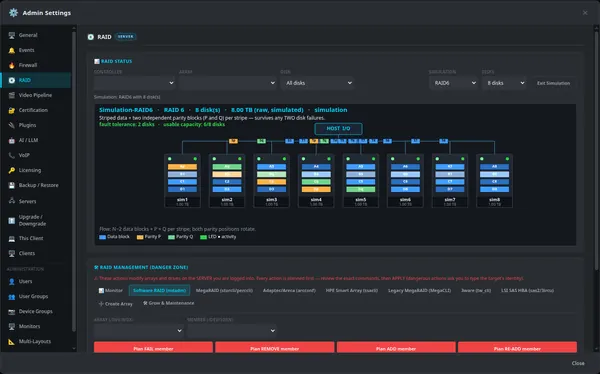
The RAID panel in the admin settings draws every disk and stripe, with data blocks and both parity positions colour-coded. This simulated RAID 6 example shows two-disk fault tolerance and usable capacity at a glance, so installers can plan storage before touching a real array.

How it works

The RAID panel in the server admin settings is a drawing engine that lays out disks, stripes and parity for the chosen level. In simulation mode you pick a level and disk count and it renders a synthetic array, so nothing real is touched. On a live server the same view is filled from the actual controller: software RAID through mdadm, or hardware controllers through their vendor command-line tools. Fault tolerance and usable capacity are calculated from the level and disk count, and the diagram shows how parity rotates across members, so installers can plan before building an array.
PotoP VMS Studio · Storage & RAID
Storage health in System Status
Desktop client

Storage health in System Status

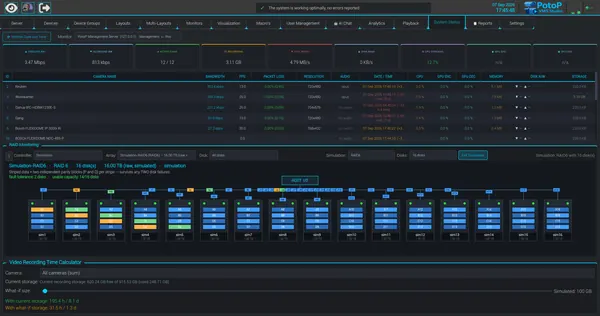
RAID monitoring sits next to live bandwidth, active cameras and recording throughput. A built-in recording time calculator turns disk capacity into hours and days of video, so operators can size retention with real numbers.

How it works

System Status polls the selected server for live figures: inbound and outbound bandwidth, active cameras, recording volume, disk read and write, and per-camera CPU, memory and storage. RAID health comes from the array controllers on that server, and this capture shows a simulated array. The recording time calculator divides the free recording space, or a what-if size set with the slider, by the measured bitrate of the cameras. It gives hours and days of retention from real stream data rather than from an estimate typed in by hand.

PotoP VMS Studio · Storage & RAID
Nested RAID 60 across groups
Desktop client

Nested RAID 60 across groups

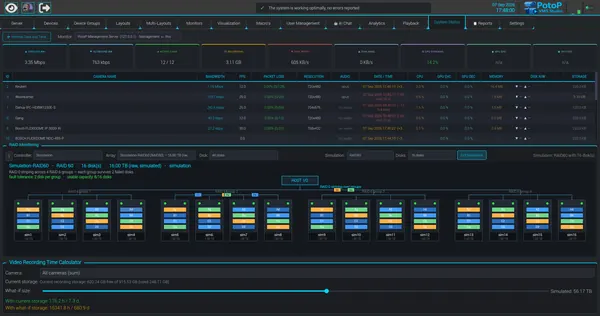
RAID 60 stripes over several RAID 6 groups, and the diagram shows how each group tolerates its own disk failures. The calculator underneath translates the resulting capacity into recording time.

How it works

The same RAID monitor can draw nested levels. Here a simulated RAID 60 of sixteen disks is shown as four RAID 6 groups, with striping across the groups on top. The panel works out fault tolerance per group, so each group survives two failed disks, and usable capacity as eight of sixteen disks. The what-if slider below feeds that capacity into the recording time calculator, which divides it by the measured camera bitrate. Planning is done on the server data without changing any disks.

PotoP VMS Studio · Storage & RAID
Create arrays from the client
Desktop client

Create arrays from the client

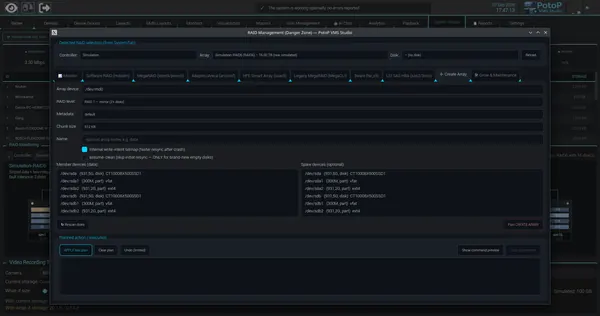
Build a software RAID array by choosing device, level, chunk size and members from the detected disks. Every step is planned first and shown as a command preview, so nothing changes until you confirm.

How it works

The RAID Management dialog runs in the desktop client but acts on the server you are logged into. An administrator re-enters their password to obtain a short-lived admin token. Creating an array builds a plan: the server lists detected disks and prepares the exact command as an argument list, never a shell string, and shows it as a preview. Nothing runs at plan time. Apply executes only that stored plan through a fixed allowlist of RAID tools, and dangerous actions ask you to type the target's identity first. Software RAID uses mdadm.

PotoP VMS Studio · Storage & RAID
Grow, reshape and maintain
Desktop client

Grow, reshape and maintain

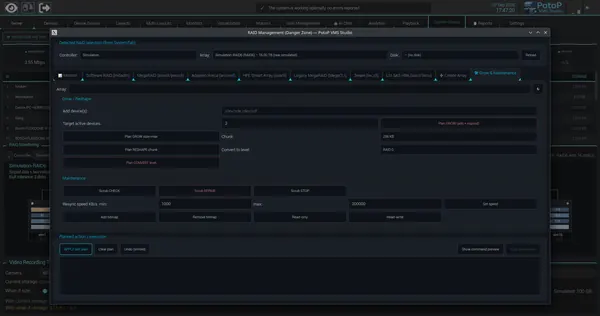
Add disks, expand an array, change chunk size or convert level, and run scrub checks and repairs. Resync speed limits let you balance maintenance against recording load.

How it works

Grow and maintenance actions follow the same plan-then-apply flow as array creation. The client sends the request, the server validates every device name and builds the exact mdadm command for adding disks, expanding, changing chunk size or converting level, and returns it for review. Scrub check and repair start the kernel's consistency scan on the array. Minimum and maximum resync speed are the standard Linux software RAID limits, so a rebuild can be slowed while cameras are recording. Applying needs the admin token and, for risky steps, identity confirmation.

PotoP VMS Studio · Storage & RAID

News