Search

19 result(s) for “playback”

Products

Screens

Playback with event timeline
Web client

Playback with event timeline

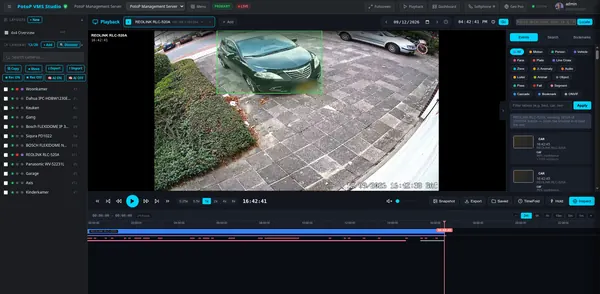
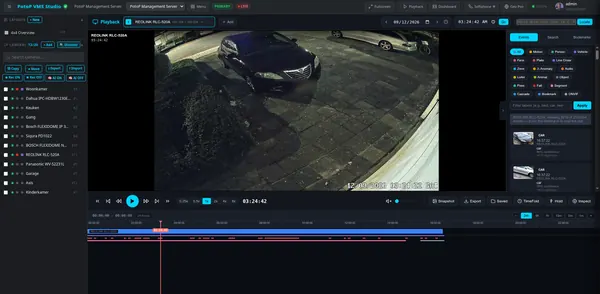
Pick a camera and a date, and the timeline shows recorded periods with motion and detection marks. The event panel lists detected cars, people and more with thumbnails, so you jump straight to what matters.

How it works

Recordings are stored as time-stamped segments on the server. When you pick a camera, a single WebSocket channel pushes the list of recorded periods and the stream of detection events, so the timeline fills without polling. Events come from the analytics database, where the AI pipeline wrote every motion, person, vehicle and plate detection with a thumbnail. The filter chips narrow the list by type. The server decrypts segments in memory when needed and serves the video to the browser. Clicking an event moves the playhead to that moment.
PotoP VMS Studio · Playback & recording
Detections drawn on recordings
Web client

Detections drawn on recordings

Recorded video plays with the detected object outlined, and the side list shows the class and confidence of each detection. Investigators find the vehicle or person they need without scrubbing through hours of footage.

How it works

While the AI pipeline watched the live stream, it stored each detection with its class, confidence, bounding box and a thumbnail in the analytics database. Playback reads those rows for the moment being shown and draws the box over the video in the browser, so nothing is burned into the recording. The side list is fed by the same rows and shows class, time and confidence. Clicking an entry seeks the recording to that instant. The tracker also counts how many sightings belong to one object, which helps separate one parked car from many passing ones.

PotoP VMS Studio · Playback & recording
Identify an object at playhead
Web client

Identify an object at playhead

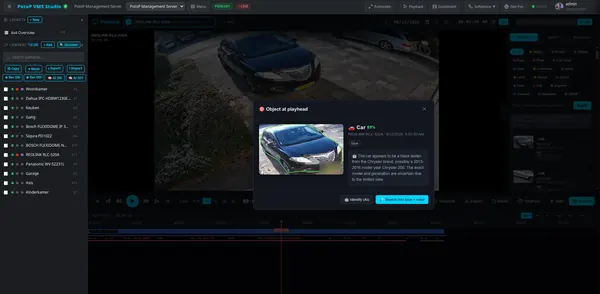
Pause on any frame and inspect the object under the playhead. The assistant describes what it sees, and one button searches the recordings for the same type and colour.

How it works

Inspect takes the frame under the playhead and sends it to the server, which runs the detector on it and cuts out the object with its mask. The Identify button passes that crop to a vision language model configured in the AI settings, running locally or through a provider you choose, and shows its description. Colour comes from the crop itself. Search this type and colour then queries the analytics database for detections of the same class and colour across the recordings. The description is a model's best guess, and it says so when the view is poor.

PotoP VMS Studio · Playback & recording
TimeFold video synopsis
Web client

TimeFold video synopsis

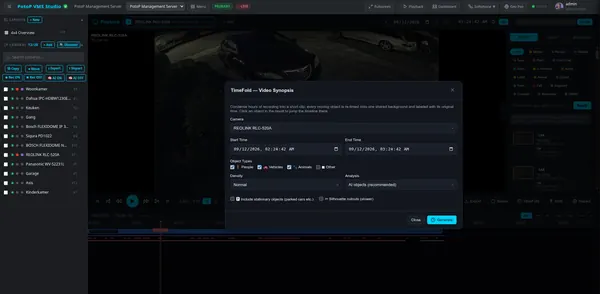
TimeFold condenses hours of recording into a short clip by overlaying moving objects on one shared background. Choose the time range, object types and density, then generate the summary.

How it works

The server walks the recorded segments for the chosen range, decrypting them in memory, and samples frames. A background-subtraction gate skips empty frames, so the object detector and tracker only run where something moves. Each tracked object becomes a tube of cropped frames with its original timestamps. Tubes are rescheduled to play at the same time over one shared background, and ffmpeg renders the result as an MP4 with each object's real time burned in. The job runs in the background with progress polling and can be cancelled. Clicking an object jumps the timeline to its original moment.

PotoP VMS Studio · Playback & recording
Encrypted, watermarked export
Web client

Encrypted, watermarked export

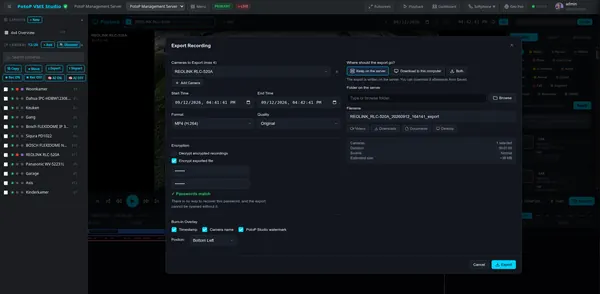
Export a time range to the server or to your own computer as MP4, with optional AES encryption and a burned-in timestamp, camera name and watermark. The recipient needs the password, so evidence stays protected.

How it works

The server cuts the requested time range from the recorded segments with ffmpeg, decrypting encrypted recordings in memory if you ask. Timestamp, camera name and watermark are burned into the picture. If you enable encryption, the MP4 is encrypted with AES-256 using a key derived from your password by PBKDF2, and a signature file is written beside it. The password is never stored, so nothing can recover it. The result stays on the server, downloads to your computer, or both, depending on the destination you choose.

PotoP VMS Studio · Playback & recording
Standalone player for exports
Standalone player

Standalone player for exports

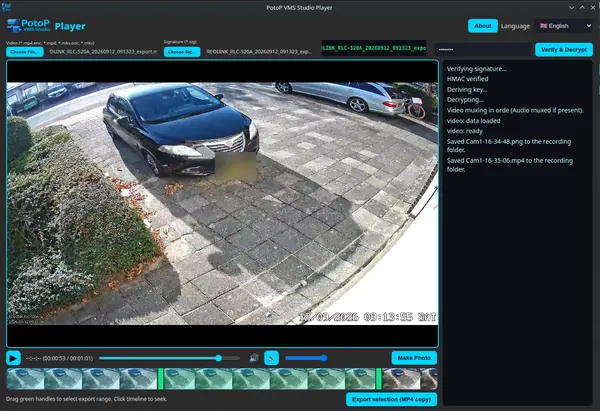
The PotoP Player opens encrypted exports, verifies the signature and decrypts them with the password. You can then trim a selection, take a photo or export an MP4 copy.

How it works

The player runs on any computer without a PotoP server. You choose the encrypted video and its signature file, and enter the password. It first checks the signature with an HMAC to prove the file is unchanged, then derives the key from the password with PBKDF2 and decrypts with AES-256. The clear video exists only in memory while it plays. From there you can drag the green handles to trim a selection, save a still picture, or export a plain MP4 copy. A browser-based variant ships inside export folders with launchers for Linux, Windows and macOS.

PotoP VMS Studio · Playback & recording
Recording rules per camera
Web client

Recording rules per camera

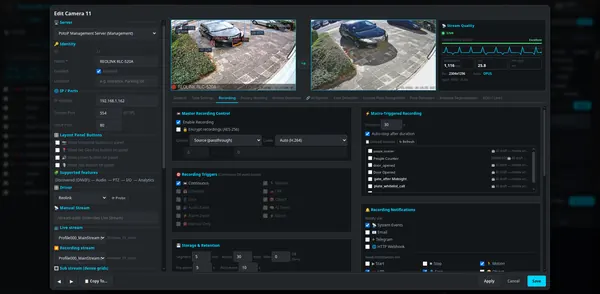
Set continuous, scheduled or event-triggered recording per camera, with encryption, storage and retention options. Macros and notifications can react to the recording events.

How it works

Each camera has its own recording settings stored on the server, and the recorder applies them as soon as you save. Triggers can be continuous, a weekly schedule, or events such as motion, person, plate, an alarm input or a macro, with pre-event and post-event buffers so the moment before the trigger is kept. Segments are cut at a set length and can be encrypted with AES-256 after they are closed. Retention removes old segments by age or by maximum size. Start, stop and detection events can raise notifications through system events, email, Telegram or a webhook.

PotoP VMS Studio · Playback & recording
Search every detection
Desktop client

Search every detection

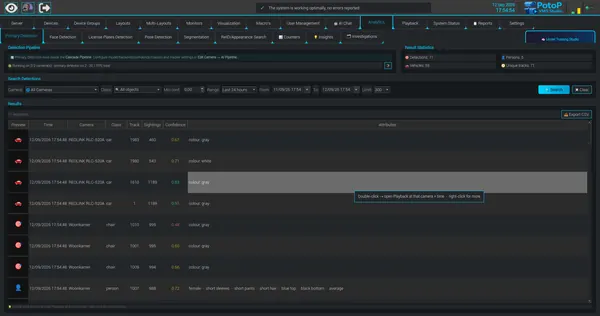
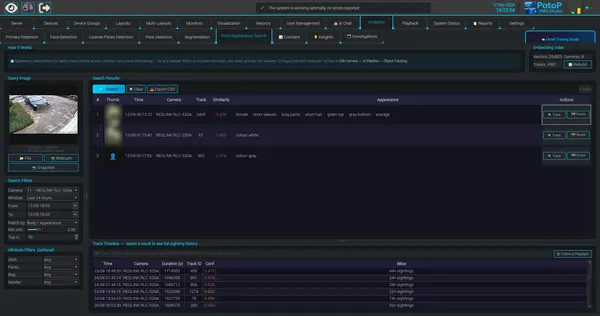
Search objects detected by every camera, filtered by camera, class, confidence and time. Results carry attributes such as colour and clothing, and a double-click opens Playback at that exact moment. Export the list to CSV for further work.

How it works

Every detection produced by the AI pipeline is written to the analytics database with camera, class, confidence, time, a track ID and attributes. The search screen runs a filtered query against that database, so it answers in one step across all cameras. Attributes such as colour, clothing and hair are derived by classifying the object's crop at detection time. Double-clicking a row opens Playback at that camera and time. The Export CSV button writes the current result list to a file, and the statistics box counts persons, vehicles and unique tracks.

PotoP VMS Studio · Analytics
Follow a person across cameras
Desktop client

Follow a person across cameras

Appearance search finds the same person or vehicle on other cameras using visual embeddings, without needing a face. Select a result to load its route and sighting history, then follow it in Playback.

How it works

Each person or vehicle crop is turned into a 256-value appearance vector by a small re-identification model running on OpenVINO, and stored in the analytics database. Searching embeds the query picture the same way and compares it with the stored vectors by cosine similarity, using an in-memory index so the result is exact and quick. Because it matches overall appearance and not a face, it works on people seen from behind or at low resolution. Selecting a result loads that track's sighting history and route, and Follow in Playback opens the recordings.

PotoP VMS Studio · Analytics
Link user groups to cameras
Desktop client

Link user groups to cameras

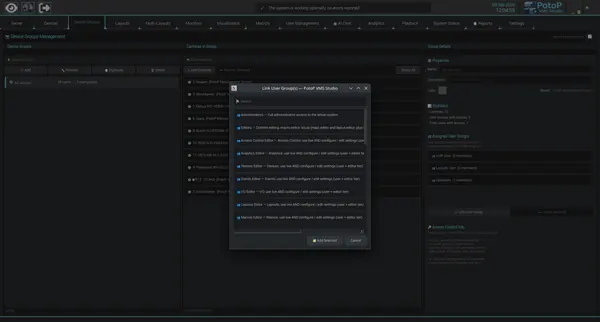
A device group is linked to one or more user groups from a searchable list that shows what each group can do. Members of those groups see the cameras in the device group and nothing else. This keeps access rules readable.

How it works

The picker lists all user groups with a short description of what each is allowed to do, and a search field narrows the list. Adding a group stores a link between that user group and the device group on the server. From then on, every member of that group gets the group's cameras in live view, playback and layouts, and no others through this link. Linking and unlinking is one step and takes effect for signed-in users without a restart.

PotoP VMS Studio · Devices
Full menu, not a reduced app
Android app

Full menu, not a reduced app

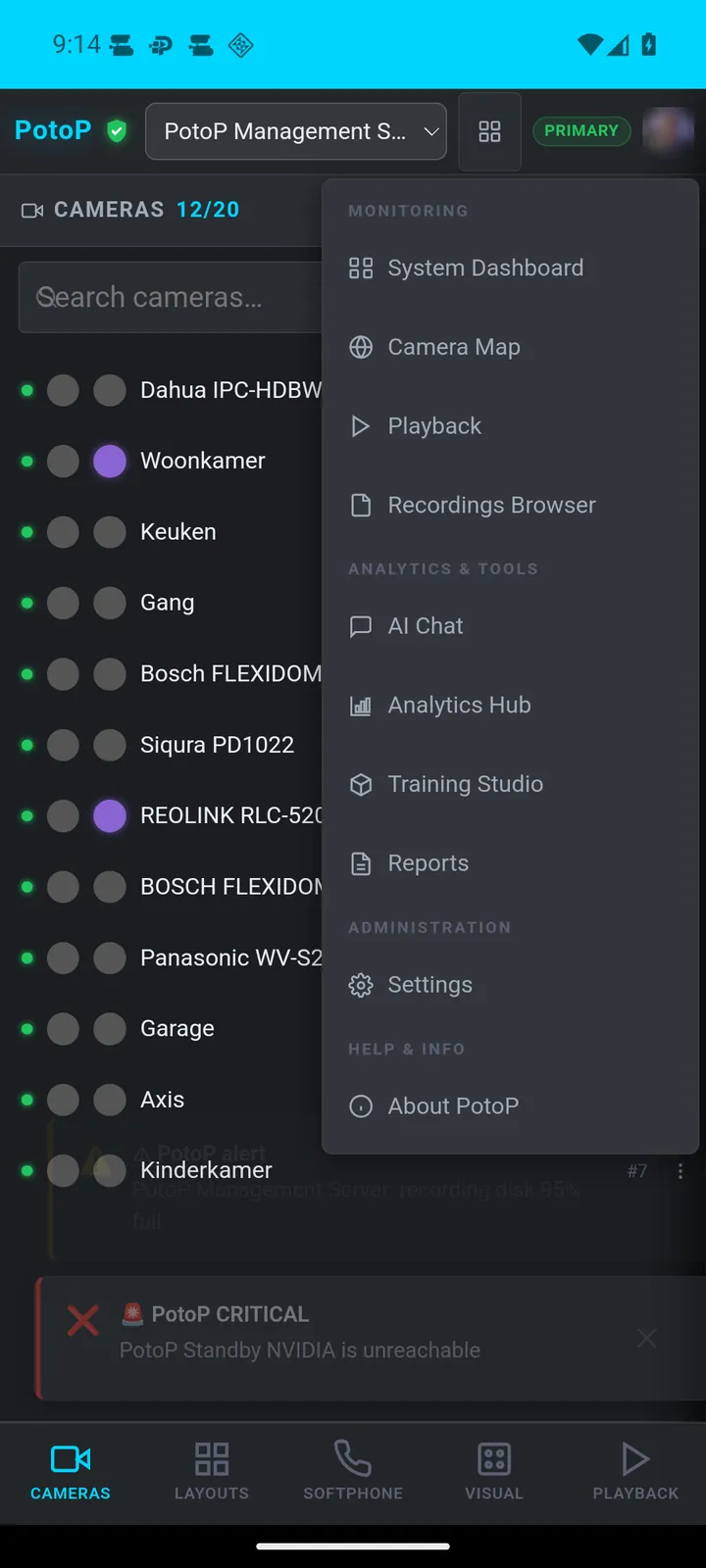
The menu reaches the camera map, playback, recordings browser, AI chat, analytics hub, training studio, reports and settings. The phone gets the same tools as the web client.

How it works

The app is a native shell around the complete PotoP VMS web client, which is why the menu is not a cut-down mobile edition. The client is served by the PotoP server and only that server, and any standby server it fails over to, is shown inside the app. Links to other sites are handed to the phone's browser, dialler or maps. Because the client is loaded from the server, a server update brings new features to the phone without an app update.

PotoP VMS for Android · Your cameras everywhere
Playback with a timeline
Android app

Playback with a timeline

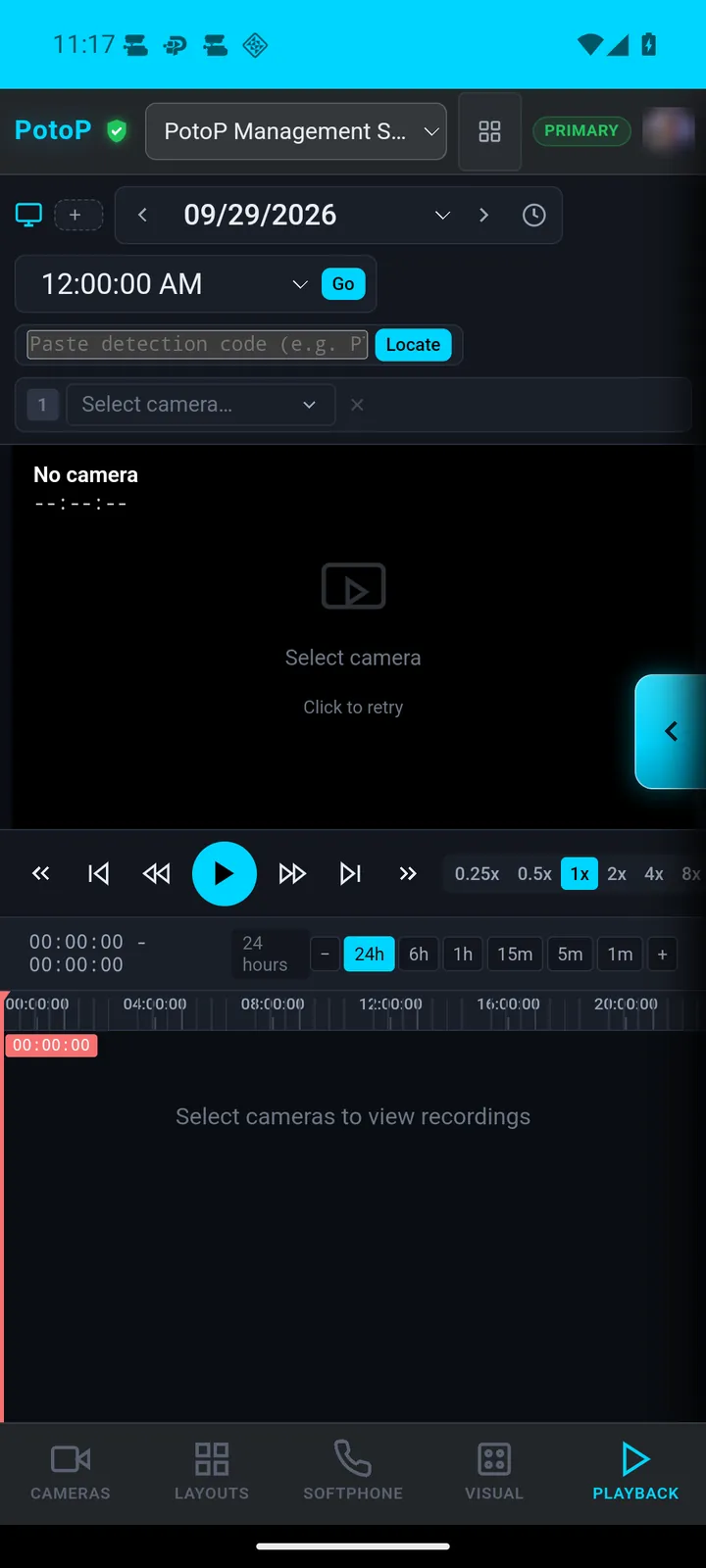
Pick a camera and a date, then step through recordings with speed controls from 0.25x upward and a 24-hour timeline. Incidents can be reviewed from anywhere.

How it works

Playback reads the recordings that the PotoP server wrote to its own storage. Choosing a camera and day asks the server which time ranges exist, which draws the 24-hour bar, and the chosen moment is streamed back to the phone over a WebSocket connection. Speed changes are applied by the server side player, so slow motion and fast forward need no work on the phone. Encrypted recordings are decrypted on the server for authorised users only.

PotoP VMS for Android · Playback & visualization
Floor plan with live devices
Android app

Floor plan with live devices

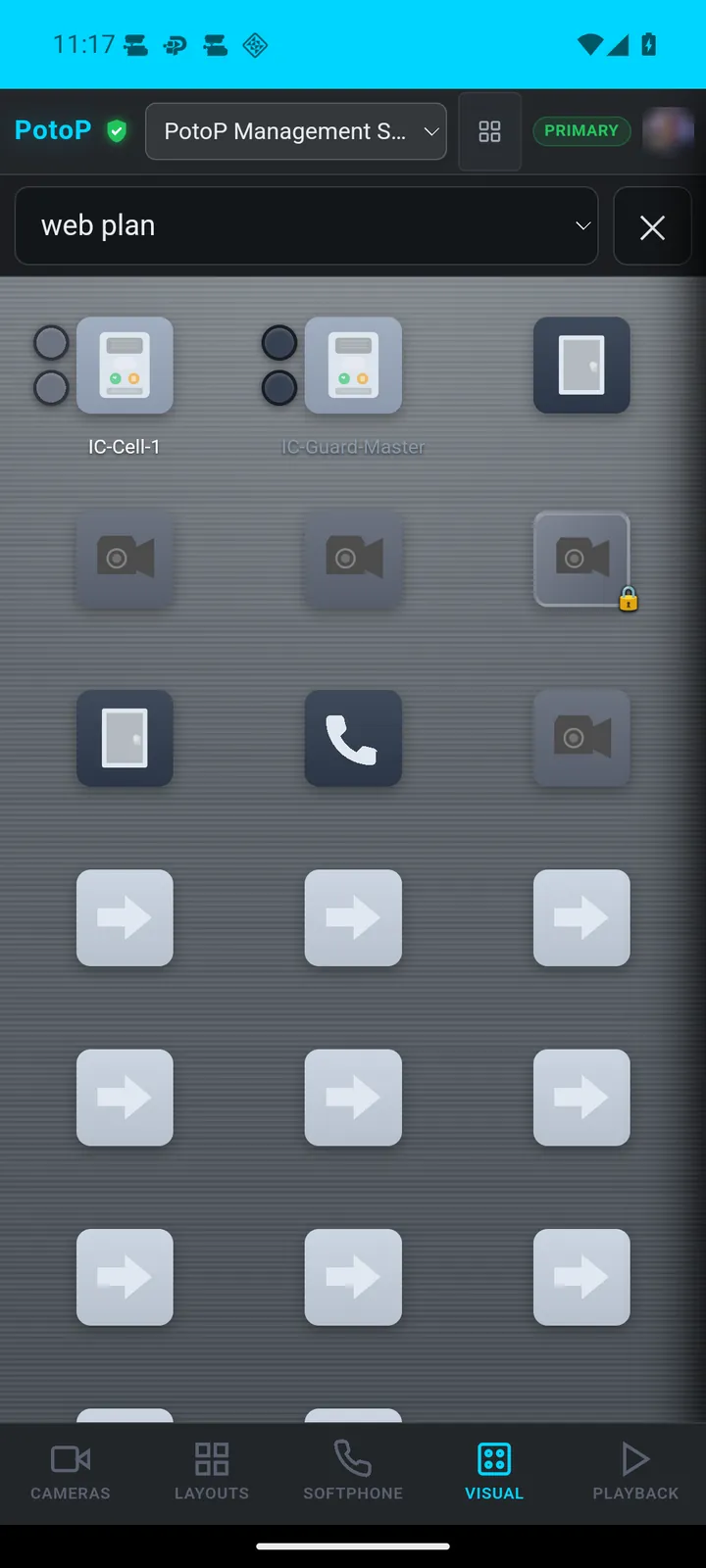
Visualization shows a plan with cameras, doors and intercom devices placed on it. Touch a device on the plan to work with it in context.

How it works

The plan is an image with device markers placed on it by an administrator in the VMS visualization editor. The markers are stored on the server with their device type and reference, so the phone only renders them. A live update channel from the server refreshes their state while the page is open. Touching a camera, door or intercom opens the corresponding live view or action in the same client, using the permissions of the signed-in user.

PotoP VMS for Android · Playback & visualization
Device status on the plan
Android app

Device status on the plan

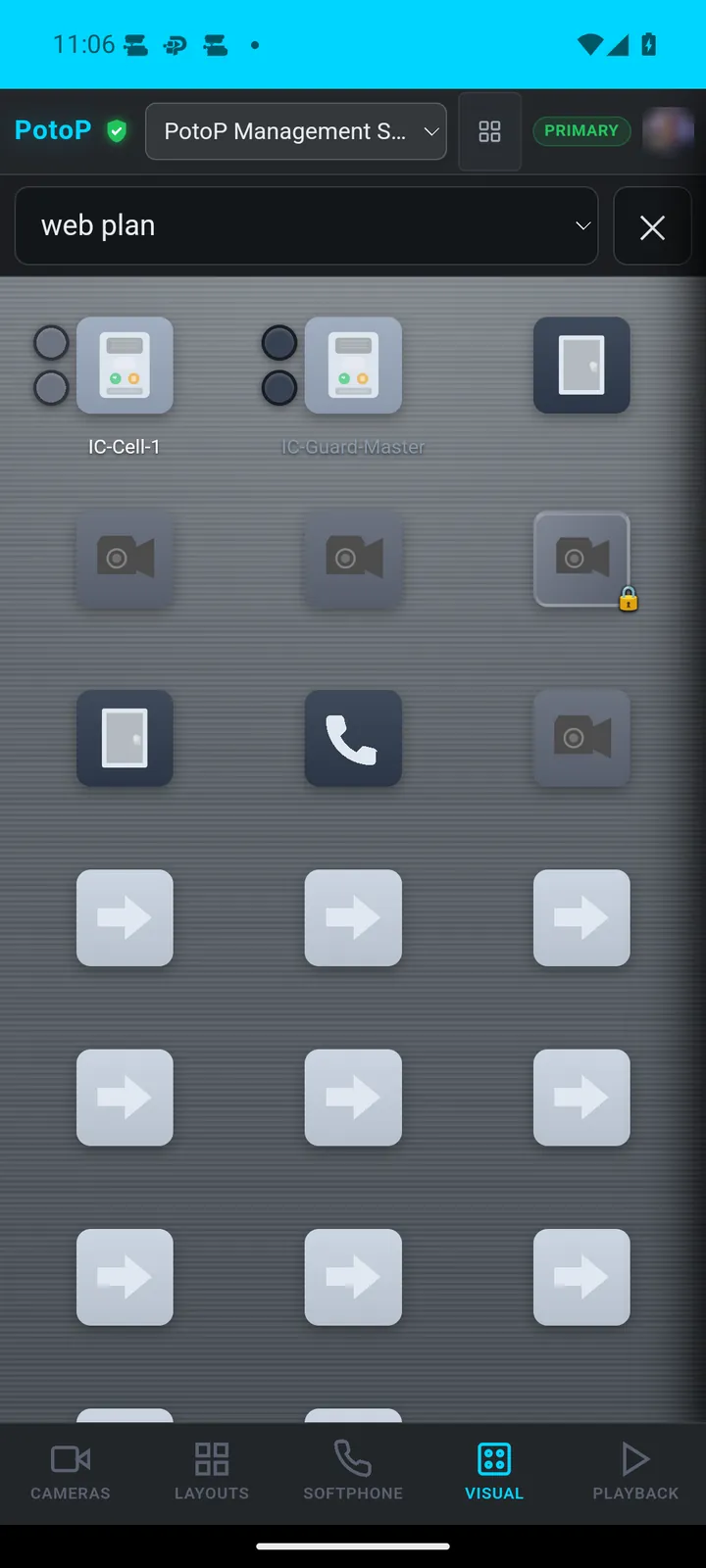
Devices on the plan carry their own status badges, such as a lock or a call icon. The plan stays readable while showing what needs attention.

How it works

Each marker on the plan is bound to a real device, and the server sends state changes to the open plan, such as a lock opening or an incoming call. The badge is drawn by the web client from that state, in the corner of the device icon. Because the state comes from the device drivers on the server, the phone does no polling of the devices and needs no network access to them. Only users allowed to operate a door or call an intercom can act on it.

PotoP VMS for Android · Playback & visualization
Search detections and events
Android app

Search detections and events

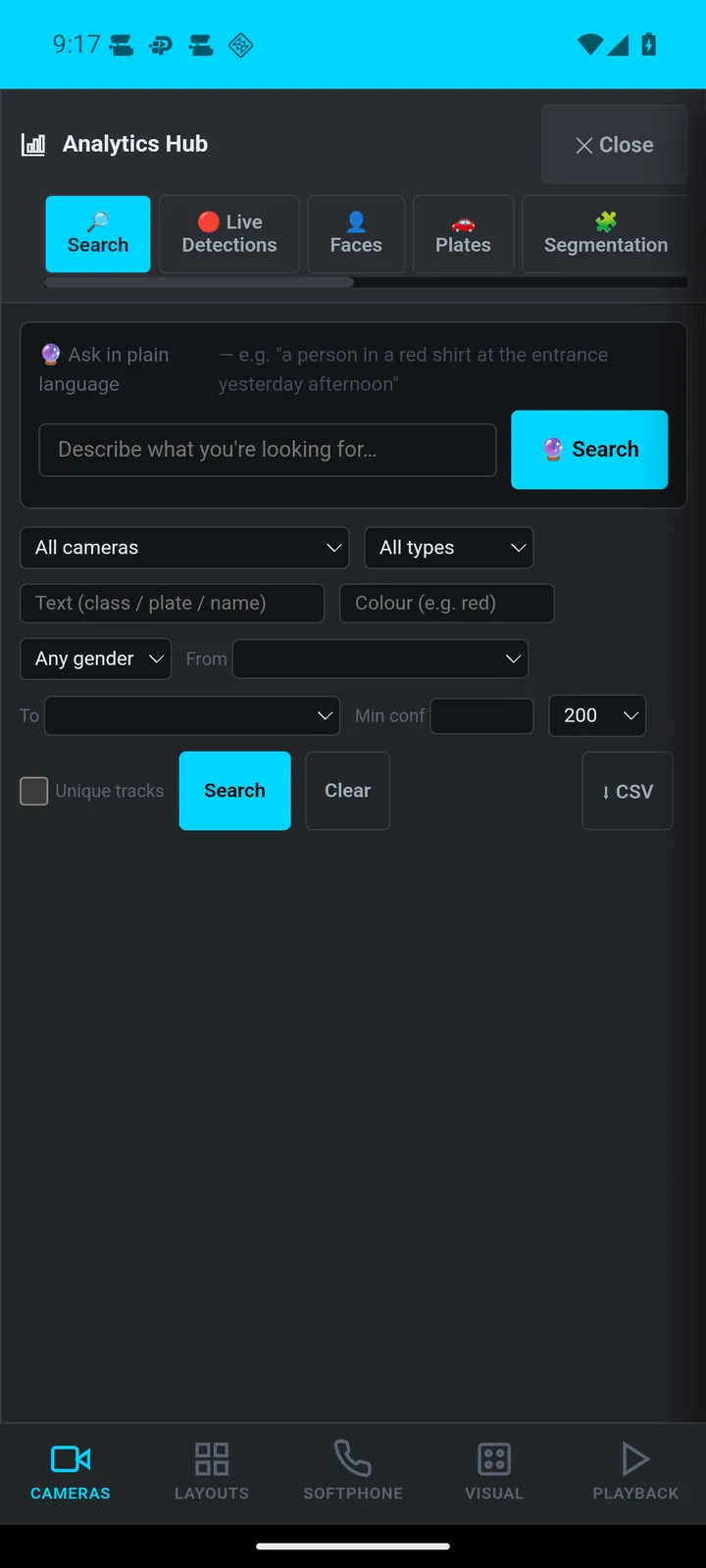
The Analytics Hub searches detections by text, gender, colour and confidence, with tabs for faces, plates and segmentation. Results export to CSV.

How it works

The AI analytics run on the PotoP server, on its GPU or CPU using ONNX-based models, not on the phone. Detections such as people, faces and plates are written to the analytics database together with attributes like colour, gender and confidence. The hub sends the search terms to the server, which queries that database and returns matching entries with their snapshots. The CSV export is produced by the server and saved to the phone's Downloads folder by the app.

PotoP VMS for Android · Playback & visualization
Recordings browser
Android app

Recordings browser

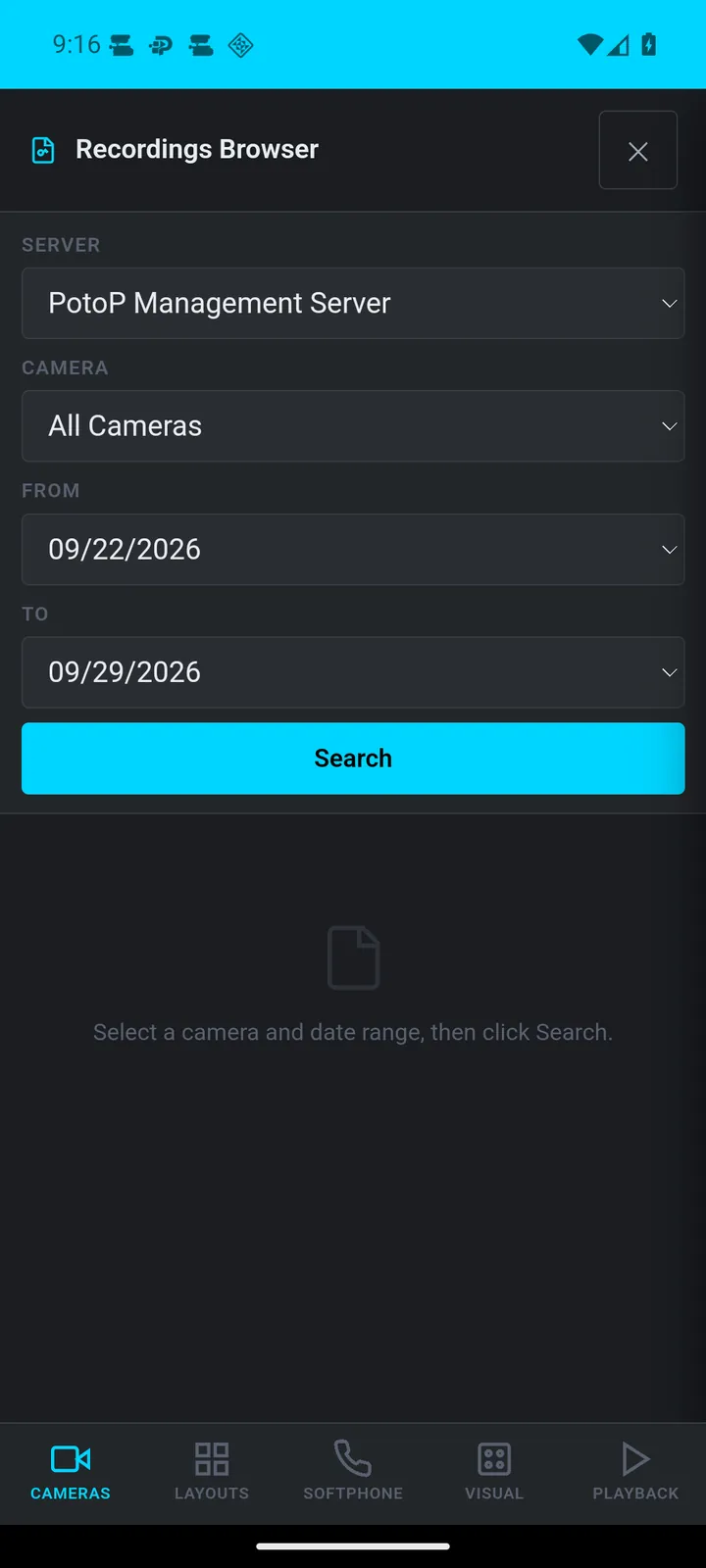
Choose a server, camera and date range to list recordings. It is meant for finding a specific clip quickly on a phone.

How it works

The browser lists recording segments held on the chosen PotoP server, filtered by camera and date range. The server can be any node of the installation, including standby servers, so the picker follows what the web client knows about the cluster. A result opens in playback at the selected time. Recordings are not copied to the phone unless you download a clip, and every request is checked against the signed-in user's rights.

PotoP VMS for Android · Playback & visualization

News